
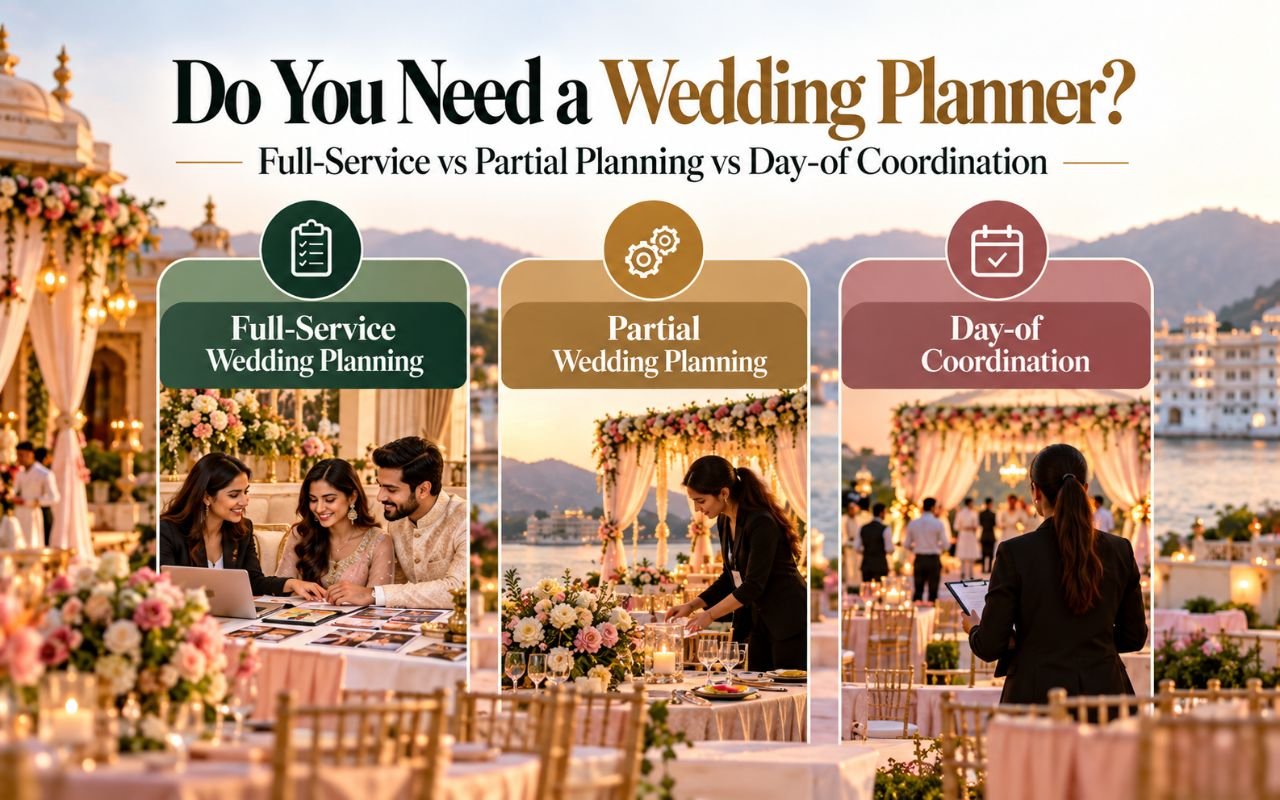
Once the engagement celebrations settle down, most couples reach the same question: do we actually need a wedding planner, and if so, how much help do we need? Some couples want someone to take over everything from the first venue visit to the last farewell. Others have already booked the venue and only want an expert to bring it all together.
In India, wedding planning support usually falls into three levels: full-service planning, partial planning and day-of coordination. Each one suits a different kind of couple, budget and wedding. In this guide, our team at Evora Event explains what each level really includes, what it typically costs, and how to decide which one is right for you.
If you’re still working out your overall budget, read our destination wedding cost guide for 2026 alongside this one.
What Does a Wedding Planner Actually Do?
A good wedding planner is part project manager, part designer and part problem-solver. Depending on the level of service, a planner’s work can cover:
Budgeting and planning: setting a realistic budget, tracking spend and building a timeline so nothing is left to the last minute.
Venue selection and booking: shortlisting venues that fit your guest count and style, arranging site visits and negotiating contracts.
Vendor sourcing and management: finding and coordinating decorators, caterers, photographers, artists, makeup and sound teams.
Décor and design: creating a theme and concept that runs through every function, from the mehendi to the reception.
Guest hospitality: room allocation, welcome kits, airport pickups and an on-ground help desk for your guests.
On-ground execution: running every function to a minute-by-minute schedule so the family can enjoy the day instead of managing it.
You can see how we handle each of these on our wedding planning services page.
Full-Service Wedding Planning: The Complete Package
With full-service planning, your planner is involved from the very beginning, usually 9–12 months before the wedding. They help set the budget, find the destination and venue, build the vendor team, design the décor, manage guest travel and stays, and run every function on the ground.
You still make every important decision, but you’re choosing between well-researched options rather than chasing quotes and follow-ups yourself.
Full-service planning is best for: destination weddings, multi-day celebrations with several functions, guest lists above 150, couples with demanding jobs, and NRI families planning a wedding in India from abroad.
Partial Planning: Expert Help Where You Need It
Partial planning suits couples who have already made the big decisions, usually the venue and date, and now need a professional to take the rest forward. The planner typically joins 3–6 months before the wedding and takes over vendor selection, décor, guest logistics and execution.
It’s a practical middle ground: you keep control of the choices you’ve already made, and hand over the parts that take the most time and experience to get right.
Partial planning is best for: couples who’ve booked a venue in their home city or nearby, families with some planning experience, and weddings where one or two functions need specialist attention.
Day-of Coordination: A Calm, Well-Run Wedding Day
Despite the name, good day-of coordination starts well before the wedding day, usually 4–8 weeks ahead. The coordinator reviews your vendor contracts, confirms timings with every vendor, builds a detailed run-sheet and then manages the functions on the ground.
What day-of coordination doesn’t include is sourcing vendors, designing décor or negotiating with venues. You need to have those in place before the coordinator steps in.
Day-of coordination is best for: smaller, local weddings where the family has already booked every vendor and simply wants someone reliable to run the day so they can be present with their guests.
Full-Service vs Partial Planning vs Day-of Coordination: Side-by-Side
| Full-Service | Partial Planning | Day-of Coordination | |
|---|---|---|---|
| Planner joins | 9–12 months before | 3–6 months before | 4–8 weeks before |
| Venue search | Included | Usually already booked | Already booked |
| Vendor sourcing | All vendors | Remaining vendors | Not included |
| Décor and design | Full concept | Included | Not included |
| Guest hospitality | Travel, rooms and help desk | Usually included | On the day only |
| On-ground execution | All functions | All functions | All functions |
| Best for | Destination and large weddings | Venue already booked | Small, fully planned local weddings |
How Much Do Wedding Planners Charge in India?
Wedding planners in India generally charge in one of three ways: a fixed planning fee, a percentage of the total wedding budget, or a per-function fee. For full-service destination weddings, planning and coordination typically works out to roughly 8–12% of the overall budget. Partial planning and day-of coordination cost less because the planner is involved for a shorter period.
When comparing quotes, look at what’s actually included rather than just the number. Ask whether the fee covers site visits, the size of the on-ground team, travel and stay for the planning team, and how many functions are managed.
It’s also worth remembering that an experienced planner often recovers part of their fee through better vendor rates and avoided mistakes. Taxes, minimum guarantees and room-block penalties can add 20–30% to a budget that nobody is watching closely.
Why Destination Weddings Almost Always Need Full-Service Planning
Planning a wedding in another city means working with vendors you’ve never met, at a venue you may have visited only once. Day-of coordination simply can’t solve those problems, because by the time the coordinator arrives, the key decisions are already locked in.
A full-service planner handles the things that make destination weddings complex: site visits, local vendor networks, event permissions, guest travel and room blocks. For example, a Goa beach wedding involves music cut-off rules and beach permissions, and a palace wedding in Udaipur depends on guest flights and airport transfers. We’ve covered more of these realities in our post on 10 things nobody tells you about planning a Goa wedding.
Closer-to-home options such as Lonavala or a wedding in Pune can work with partial planning, especially if your family has already booked the venue.
8 Questions to Ask Before You Hire a Wedding Planner
1. Have you planned weddings at our destination before? Local experience means established vendor relationships and fewer surprises.
2. What exactly is included in your fee? Ask for a written scope covering functions, site visits and team size.
3. How big will the on-ground team be? A 200-guest, three-function wedding needs more than one or two coordinators.
4. How do you work with vendors? Find out whether you can bring your own vendors, and whether the planner earns commissions from any they recommend.
5. Can we see real weddings you’ve planned? Look at full galleries, not just a few highlight photos.
6. How do you track and report the budget? You should always know what’s been spent and what’s pending.
7. What’s your backup plan for rain or delays? Experienced planners have a plan B ready for weather, vendor no-shows and flight delays.
8. Who will be our main point of contact? One dedicated person makes communication far easier for the family.
So, Which Level of Planning Is Right for You?
Choose full-service planning if you’re getting married away from home, hosting more than 150 guests, or simply don’t have the time to manage dozens of vendors.
Choose partial planning if your venue and date are fixed and you want expert help with design, vendors and execution.
Choose day-of coordination if your wedding is small and local, every vendor is booked, and you just want the day to run smoothly without family members stepping in to manage it.
If you’re not sure where you fit, that’s completely normal. A short conversation about your guest count, destination and timeline usually makes the answer clear.
Frequently Asked Questions
Is a wedding planner worth it for a small wedding?
For a small local wedding with vendors already booked, day-of coordination is often enough. For a small destination wedding, full-service planning still makes sense because of the travel, venue and vendor logistics involved.
How early should we hire a wedding planner?
For full-service planning, 9–12 months ahead is ideal, and 12–18 months for peak-season destination weddings. Partial planning can start 3–6 months out, and day-of coordination 4–8 weeks before.
What is the difference between a wedding planner and a wedding coordinator?
A planner is involved in decisions from the start, including budget, venue, vendors and design. A coordinator focuses on confirming details and running the event once the planning is done.
Can we use our own vendors with a wedding planner?
In most cases, yes. A good planner will coordinate your chosen vendors alongside their own network and flag any gaps in advance.
Not Sure How Much Planning Help You Need?
Tell us about your destination, dates and guest count, and we'll recommend the right level of planning support for your wedding. Get in touch for a free consultation.
Talk to Our Planners
Comments are closed.



3 Replies to “Do You Need a Wedding Planner? Full-Service vs Partial Planning vs Day-of Coordination”
[…] timeline that makes the most of golden-hour views. If you’d like help deciding, our guide on choosing the right level of wedding planning support is a good next […]
[…] Discover how we plan backwater, beach and hill weddings on our Kerala wedding planner page, or read our guide to choosing the right level of wedding planning support. […]
[…] Explore our wedding planning services, learn more about our team, or read our guide to choosing the right level of planning support. […]